


Stop the Sticker Shock: Why Italian Taxis Are Nothing Like Your Uber Back In the States
If you’re coming from a major U.S. city like New York, Chicago, or LA, your first Italian taxi ride can feel like a bit of a culture shock. In the States, you’re likely used to the predictable (if pricey) world of Uber or the standard "Yellow Cab" distance-plus-time math. In Italy? It’s a little more... artistic. Here is the breakdown of how the Italian system works, how it stacks up against the U.S., and why that ride to the Amalfi Coast costs what it does.
Karen Phillips
5/14/20263 min read

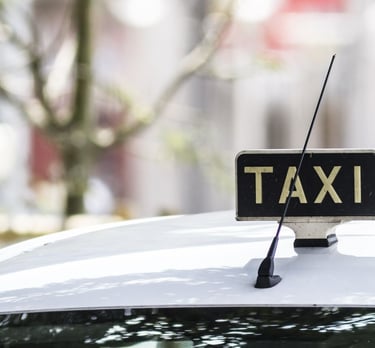
So, you’ve just landed in Napoli. You’re dreaming of your first real Margherita pizza, but first, you have to run the gauntlet: the taxi queue.
If you’re coming from a major U.S. city like New York, Chicago, or LA, your first Italian taxi ride can feel like a bit of a culture shock. In the States, you’re likely used to the predictable (if pricey) world of Uber or the standard "Yellow Cab" distance-plus-time math. In Italy? It’s a little more... artistic.
Here is the breakdown of how the Italian system works, how it stacks up against the U.S., and why that ride to the Amalfi Coast costs what it does.
1. The "Base Drop": Not All Starts Are Equal
In the U.S., a taxi meter starts at a flat rate (like $2.50 or $3.00 in NYC) regardless of the time of day.
In Italy, the Quota Fissa (starting fee) is a tiered system. If you’re traveling on a Sunday or at 22:00 (10:00 PM), you’ll see a much higher starting number on that screen—sometimes as high as €6.50 or more.
The Takeaway: Don’t panic if the meter starts high. It’s not a scam; it’s just the "night and holiday" premium baked in.
2. The "Level Up" Meter (T1, T2, T3)
This is where it gets weird for Americans. U.S. taxis usually have one rate: distance + time.
Italian meters use Progressive Tariffs.
T1 is for slow, inner-city crawling.
T2 (and sometimes T3) kicks in once you hit a certain speed or cross a city boundary.
Imagine if an NYC Yellow Cab doubled its price the moment you crossed the bridge into Brooklyn. That’s essentially what happens in Italy. When that meter clicks from "1" to "2," the price per kilometer actually increases.
3. The "Luggage Tax"
In the States, you can usually cram as many bags as will fit in the trunk for free. In Italy, your suitcase needs its own "ticket." Most cities charge about €1.00 per large bag after the first one.
Pro-Tip: If you’re calling a taxi through an app (like FreeNow or itTaxi), you’ll also see a "Chiamata" fee. This is the cost of the taxi driving to you. In the U.S., Uber "Arrival Fees" are hidden in the total; in Italy, they are added to the meter the moment the driver accepts the call.
4. Fixed Rates: Naples vs. The NYC Flat Rate
We all know the JFK-to-Manhattan flat rate. It’s simple and automatic.
Italy has these too (especially in Naples and Rome), called Tariffa Predeterminata. But here’s the catch: You have to ask for it. If you don't say the words before the driver puts the car in gear, they are legally allowed to just run the meter. In heavy traffic, the meter will almost always cost more than the fixed rate.
Why is the Amalfi Coast Transfer so Expensive?
If you’re looking at a €150 quote to get from Naples to Sorrento or Positano, you might be thinking, "That’s more than my flight!" Here’s why it’s not just a "tourist tax":
The "Empty Return": Unlike a U.S. Uber driver who can just find a new fare wherever they end up, Italian taxi licenses are tied to specific towns. A Naples driver who drops you in Positano usually can't legally pick someone else up there. You’re essentially paying for their gas and time to drive all the way back to Naples alone.
The "Coastal Factor": The roads to Amalfi are narrow, winding, and—during the summer—basically a parking lot. A 50 km trip that should take an hour can easily take three.
NCC vs. Taxi: Most "transfers" aren't actually taxis; they are NCC (Private Drivers). Think of it like booking a Black Car service instead of a cab. You’re paying for a Mercedes van, ice-cold AC, and a driver who knows how to navigate a bus-sized gap on a cliffside road without breaking a sweat.
The Bottom Line
Italian taxis are highly regulated and generally very safe, but they operate on a "local" logic that favors the drivers' time and expenses more than the U.S. system does.
My best advice? If you're going long-distance, book a private NCC transfer in advance. If you're staying in the city, always ask for the Tariffa Predeterminata and keep a few €1 coins handy for your bags!