
SUD: The Evolution of Ragù in Piazza Garibaldi, Naples
Explore the rich cultural tapestry of Naples through its iconic dish, ragù, as experienced at "SUD: L'Evoluzione del Ragù a Piazza Garibaldi." Chef Marianna Vitale guides a journey connecting traditional flavors with the diverse communities that have shaped her neighborhood.
Karen Phillips
12/15/20254 min read

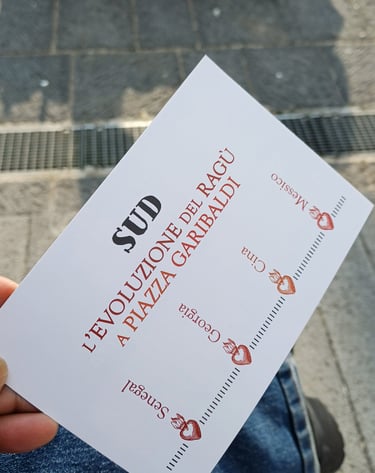
Have you ever stopped to think about how a single dish can tell the story of an entire city? In Naples, that dish is the mighty ragù, the slow-simmered, meat-rich sauce of Sunday tradition. But at a recent, fantasticaaa event called "SUD: L'Evoluzione del Ragù a Piazza Garibaldi," in Naples, I learned that the definition of ragù is in the eye of the beholder - thanks to Naples’ incredibly rich tapestry of immigrant communities. The event was part of a three day festival put on by Pessoa Luna Park.
I sat in a sunny concrete ampitheater with a couple of hundred curious spectators waiting for our voyage to begin. Our guide for this delicious and deeply personal journey was Chef Marianna Vitale. Importantly, Marianna wasn't cooking—she was sharing memories and guiding a conversation that connected a familiar dish to the complex, changing face of her childhood in the neighborhood spanning from Piazza Garibaldi to Via Carriera Grande. She defined this period (from ages 6 to 16, during the 1980s and 1990s) as "the walk of fear."

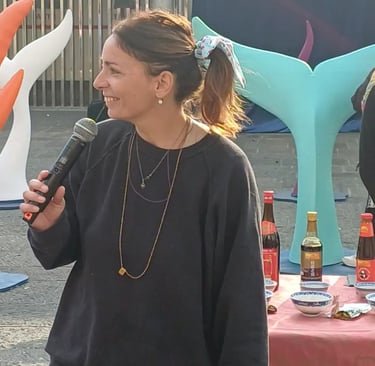
Chef Marianna Vitale
Marianna reflected on how, for her and her neighbors, any new community moving into their neighborhood initially felt unfamiliar and intimidating. This fear, rooted in the unknown, was often translated into stereotypes about each group:
The Senegalese Community (Piazza Garibaldi): Marianna recalled her mother’s unease when she returned from work, describing her as "scared" upon seeing "all Black people" (tutti neri). Marianna explained this wasn't rooted in racism but rather in an instinctive fear of the unfamiliar. Fueled by anxiety, the perceived source of local crime shifted from Neapolitans to Senegalese immigrants. Subsequently, these fears and misperceptions gradually receded.
The Georgian Community (Piazza Mancini): For years, Marianna watched older women gather around Piazza Mancini, appearing to be doing "nothing." To her young mind, this was puzzling and therefore intimidating. Eventually, she understood that these women were Georgian caregivers (badanti), enjoying their only day off to socialize and relax.
The Chinese Community (Via Carriera Grande): In the 1990s, the neighborhood experienced a change as local shops were sold to Chinese merchants. Initially, this was seen positively, as it brought wealth to those who sold their businesses. However, when Chinese workers began occupying apartments in large numbers, landlords raised rents significantly. This made housing unaffordable for many families, leading to feelings of resentment.
The South American Community (Via Oronzo Costa): This group was often misunderstood. People from various countries like Ecuador, Mexico, and the Dominican Republic were grouped together as "South Americans," primarily recognized by the vibrant Latin American music that filled the bassi (ground-floor apartments) where they lived. Women, often arriving without men, were unfairly labeled due to their lively music and traditional clothing.
Through reflection and understanding, Marianna began to see these communities not as "the other," but as individuals with their own stories and contributions to the neighborhood's rich tapestry.
Marianna explained that she brought these four communities and their stews together because they represent the exact groups that were initially seen as "the enemy," but whose new flavors now overlap and enrich the traditional aromas of Naples.
She even offered an intellectual palate cleanser: the Neapolitan ragù itself is a product of globalization! Arabs brought pasta, and tomatoes came from the Americas. If the original ragù is a fusion, why can't we embrace the new "stufati" (stews) as the next evolution?
Four skilled women, each managing their own local business, brought their unique takes on a traditional, hearty stew to the stage. Their dishes, much like the classic Neapolitan ragù, shared fascinating similarities: all were one-pot creations, focused on meat, required lengthy cooking times, and were made for bringing people together in moments of celebration and family unity.
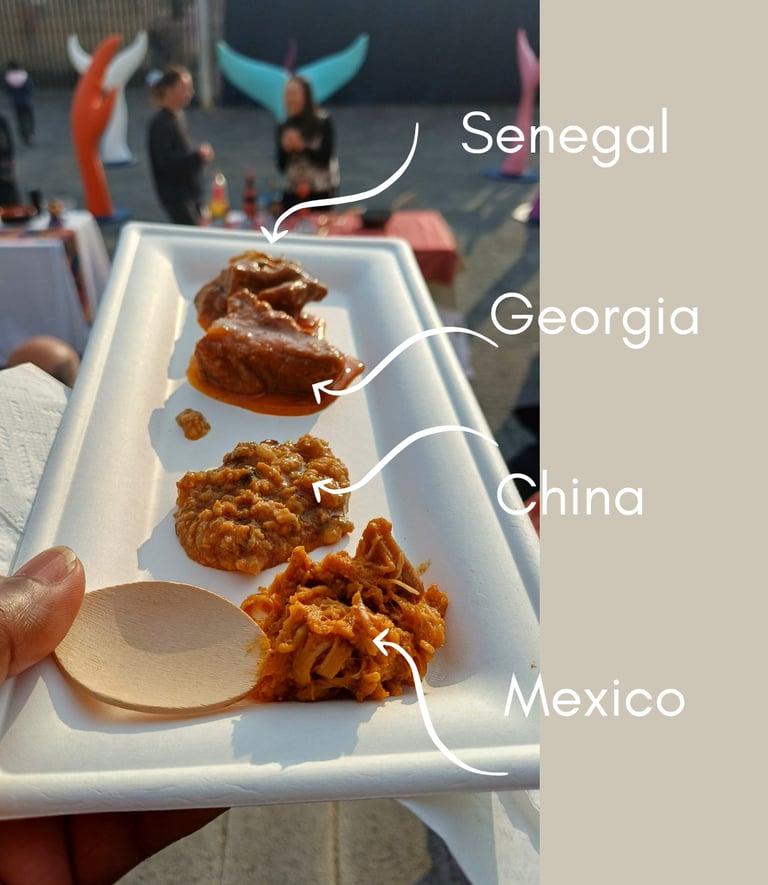
Here were the four "new to me ragùs" we sampled:
Senegal (Mafe): A rich, slow-cooked beef stew using peanut concentrate and tomato, simmered for over two hours until perfectly blended. Recipe here.
Georgia (Ostri): Presented by Elisa, this spicy beef stew incorporates traditional mountain spices like suneli (a savory blend of dried herbs) to deliver a comforting, bold flavor. Recipe here.
China (Xiang gu rou mo jiang ): A savory pork ragù from Southern China, enriched with Chinese mushrooms, fermented mustard greens, and balanced with soy and oyster sauces. It's traditionally served with "longevity noodles" for birthdays! Recipe here.
Mexico (Cochinita Pibil): Dana shared this Southern Mexican masterpiece. It features slow-cooked pork marinated with bitter orange and the unique, earthy spice achiote, representing ancient Mayan culture. Recipe here.
Each chef shared the specific order of their ingredients, a sacred practice similar to the precise steps taken when preparing a traditional Neapolitan ragù.
That afternoon, I left smiling, recalling not just the delicious stews and the stories of the women who made them, along with the chef’s memories, but also reflecting on my own journey as an immigrant arriving in Naples in the 90s .The flavors of the afternoon had awakened memories of my own first steps in this vibrant city, where the streets were filled with an unfamiliar symphony of languages and scents. I remembered the initial trepidation of blending into a place so rich with its own history, yet feeling the warmth of a community that slowly embraced the new and the different.
Just like Marianna’s reflections, my experiences were colored by the evolving faces of the neighborhoods, where every corner held a story—a tapestry woven from the threads of diverse cultures converging in one bustling metropolis. It reminded me that every dish, every conversation, and every shared meal adds to the complex narrative of a city like Naples.
As I strolled home, a profound sense of gratitude washed over me. I felt thankful for the openness and resilience that both food and people contribute, for it is through the blending of these varied elements that we craft something genuinely greater than the sum of its parts.
In Naples, ragù is more than just food; it’s a testament to the city’s knack for adapting, absorbing, and celebrating both the new and the old. Much like the ragù that simmers on the stove, blending ingredients into a harmonious dish, the city welcomes each wave of immigrants, each adding their unique flavors and stories to the vibrant tapestry of life here.